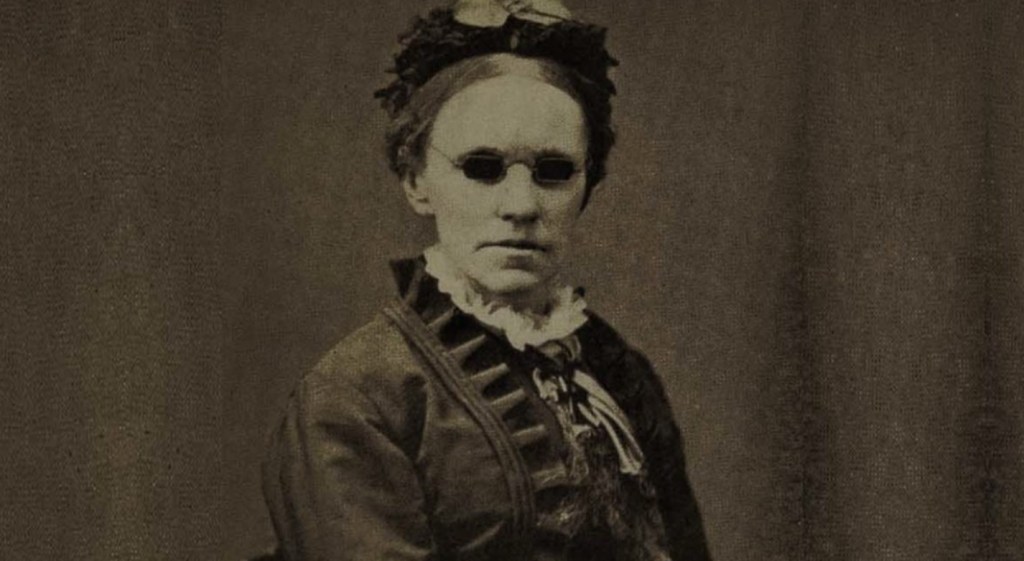
Imagine growing up blind. Imagine finding out that you developed an inflammation to your eye and a charlatan doctor caused a irreparable damage to your eye at the age of six week old that you will spend the rest of your life as a blind person. How would you feel and what would you do? This is the story of Fanny Crosby and how she overcame her disability and allow God to use her in a powerful way. Like Joni Eareckson Tada and Nick Vujicic, she is one of the Christian heroes of faith who, in spite of her tragic life, lived to glorify God and became an example for others how to honor God through her weakness. Instead of self-pity, bitterness, and blaming others, she used her hidden talent to bless many people around her. She is famous for putting words to many of our favorite hymns such as “Blessed Assurance,” “To God Be the Glory,” “Safe in the Arms of Jesus,” “He Hideth My Soul,” “Old Rugged Cross,” “Pass Me Not, O Gentle Savior,” and many more.
Frances Jane Crosby, also known as Fanny Crosby, was an American hymnwriter and poet who wrote over 8,000 hymns despite being blind from six weeks old. Born in 1820, a quack doctor’s application of a hot mustard poultice to treat an eye infection destroyed her eyesight. Instead of becoming bitter about her handicap, Crosby saw it as a blessing in disguise, believing that it allowed her to focus more deeply on her faith without the distractions of the visual world. At the age of 15, she was accepted into the New York Institution for the Blind, where she developed her academic skills and literary talents. She quickly became a talented student, mastering music, literature, and composition. Also, her ability to memorize and recite long passages of Scripture and poetry was amazing. This became the foundation of her work later. After graduating, she became a teacher at the institution, dedicating herself to educating blind students, a role that further enhanced her skills as a communicator and a compassionate leader.
In her early life, Fanny Crosby’s talents led her to write secular poetry and songs. She was a famous figure, writing poems for public events and even addressing the U.S. Congress. However, a significant turning point occurred around 1850. At this time, she had a profound spiritual awakening and dedicated her life to serving Christ. This renewal of faith led her to believe that her talents should be used exclusively for God’s glory. This realization led her to redirect her attention from secular pursuits to sacred work. As a result, she began to dedicate her writing to the Christian ministry.
The key moment when she began to write the popular and endearing hymns for which she is known occurred later in her early 40s. In 1864, at the age of 44, she was introduced to William B. Bradbury, a music publisher. He recognized her extraordinary poetic gift and challenged her to write hymns. Their partnership marked the beginning of her prolific career as a hymnwriter. Her first successful collaboration, “Safe in the Arms of Jesus,” was an immediate hit, and it was followed by a flood of compositions. Her hymns used simple language and deep theology, reaching many ordinary people. She considered her blindness to be an advantage in her work, as it allowed her to focus more deeply on her writing and avoid external distractions. Her hymns became a powerful tool for evangelism and comfort for countless Christians. She devoted much of her life to helping the poor in New York’s slums, offering faith and compassion to those in need. She died in 1915, leaving behind a legacy of over 8,000 hymns that continue to inspire and bless.people worldwide.



 word-centered living
Leave a comment