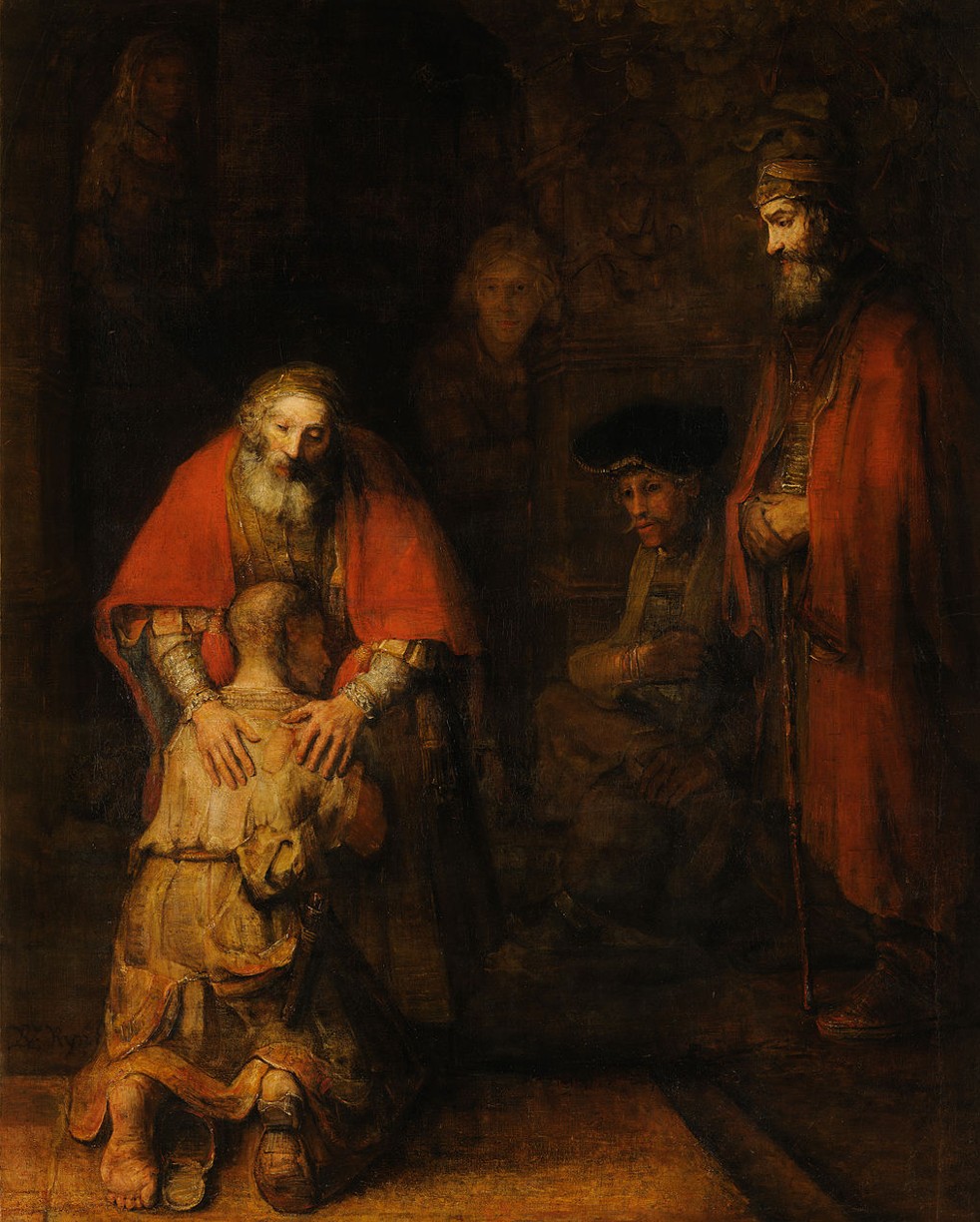
Here is a personal, reflective, and artistic look at the Parable of the Prodigal Son by Henri J.M. Nouwen. In his book, “The Return of the Prodigal Son: A story of Homecoming,” Nouwen explores the three main characters of the story: the younger son, the elder son, and the father. In 1983, he experienced a deep connection with Rembrandt’s painting of the story in his famous “The Return of the Prodigal Son,” while he was spending time at L’Arche, a community that offers a home to people with mental handicaps. He felt touched by the image of the hands of the father, welcoming, comforting, and renewing the younger son’s return that he saw himself as the younger son being comforted by the hand of the Heavenly Father. Later, he was able to see the real painting in Saint Petersburg, Soviet Union, in 1986. This experience helped him to transition his life ministry from teaching to ministering to the mentally handicapped people. It is at this place that he began writing some of the deep-thinking books. Based on his writings, I don’t truly know whether he is saved or not, but it makes me feel that he may have understood the heart of the gospel of God.
Nouwen’s analysis is more than a sermon, but a spiritual self-reflection of himself. First, he sees the younger son not just as a sinner who squanders his inheritance, but as a representation of all who seek to find themselves and their freedom in the world, only to end up feeling lost and empty. Nouwen asserts that it embodies the human desire to escape, to stray, and the eventual realization of the need for home and reconciliation. He even expresses that he identifies with the younger son’s journey of feeling alienated and then finding his way back to his spiritual home, an experience he saw mirrored in his own life.
Second, Nouwen was shocked to discover that he could also identify with the older son. He argues that the elder brother’s resentment, jealousy, and self-righteousness are often overlooked. He sees this character as a representation of those who stay within the confines of duty and obedience but harbor a cold, unforgiving heart. This brother struggles with an inability to celebrate the return of his brother, upholding his own perceived righteousness and hard work. Nouwen emotionally describes this character as being “lost at home,” a concept many Christians can relate to. He uses this character to challenge the reader to confront their own judgmental attitudes, lack of mercy, and inability to truly embrace unconditional love.
Finally, Nouwen presents the father as the ultimate image of God’s unconditional love and compassion. The father’s embrace of his lost son, his generous celebration, and his gentle plea to the elder son to join in the joy, embody the very essence of God’s welcoming and forgiving heart. He invites Christians to see themselves not only as the prodigal and the elder son, but also to aspire to become the father—the one who offers forgiveness, mercy, and compassion without reservation. This perspective shifts the focus from being a recipient of grace to being a channel of it. To me, this was the most impactful part of the book, as it reminded me that this is what God desires of all of us, that is, to be holy as He is holy. Apostle Paul also exhorted, “Therefore be imitators of God, as beloved children” (Eph.5:1). Again, he implored, “Be imitators of me, just as I also am of Christ” (1 Cor.11:1). This is the heart of the Great Commandment, that is, to love God with all our heart, soul, mind, and might, and to express it to others around us. I am glad that Nouwen pointed this out to me in the story of the Prodigal Sons and their father!
Henri J. M. Nouwen (1932-1996) was a Dutch Catholic priest, professor, and writer known for his influential books on Christian spirituality. He taught at prestigious institutions like the University of Notre Dame, Yale, and Harvard, but found his true calling and spiritual home later in life. In 1985, he left his academic career to become a pastor at the L’Arche Daybreak community in Toronto, Canada, a place where people with and without intellectual disabilities live and work together. This community profoundly impacted his life and work, and it was there that he wrote some of his most famous books. Nouwen’s writing is characterized by its deep vulnerability, psychological insight, and honest exploration of his own struggles with loneliness, doubt, and the search for belonging. His work continues to resonate with readers from various faith traditions, making him one of the most beloved spiritual writers of the 20th century.


 word-centered living
Leave a comment