
Have you ever studied the prayers of Jesus? The disciples once asked Jesus to teach them how to pray. Then, in response, the Lord taught them a prayer model known as “The Lord’s Prayer.” However, the Lord’s Prayer is not necessarily one that Jesus himself prayed but more like a template on who, what, and how we should pray appropriately to God. Therefore, I did a search for prayers that Jesus himself prayed, and I discovered about ten major ones. I examined them to learn who, what, why, where, and how of his prayers and looked for lessons on how to pray better to God. Here is my listing of those prayers. The first six records actual prayers he uttered, and the latter only describe them.

10 Instances of Jesus Praying
1. For personal strength to obey God’s will – To the best of my knowledge, this is the only instance where Jesus prayed for himself. It was probably the most important prayer he offered for himself, and what did he pray for? It was for strength to obey the will of the Father. I concluded this way because of the manner in which he prayed and the help he received from angels.
“And He withdrew from them about a stone’s throw, and He knelt down and began to pray, saying, ‘Father, if Thou art willing, remove this cup from Me; yet not My will, but Thine be done.’ Now an angel from heaven appeared to Him, strengthening Him. And being in agony He was praying very fervently; and His sweat became like drops of blood, falling down upon the ground.” (Lk.22:41-44, cf. Mt.26:39-46, Mk.14:35-42, Jn.18:1)
2. For God’s people to become unified with God and each other – This is the second most crucial prayer Jesus prayed, as he prayed for oneness between God the Father, himself, and all believers. It shows that he highly valued unity in the body of Christ.
“These things Jesus spoke; and lifting up His eyes to heaven, He said, ‘Father, the hour has come; glorify Thy Son, that the Son may glorify Thee, even as Thou gavest Him authority over all mankind, that to all whom Thou hast given Him, He may give eternal life…’” (Jn.17:1-2)
“And I am no more in the world; and yet they themselves are in the world, and I come to Thee. Holy Father, keep them in Thy name, the name which Thou hast given Me, that they may be one, even as We are…” (Jn.17:11)
“I do not ask in behalf of these alone, but for those also who believe in Me through their word; that they may all be one; even as Thou, Father, art in Me, and I in Thee, that they also may be in Us; that the world may believe that Thou didst send Me. And the glory which Thou hast given Me I have given to them; that they may be one, just as We are one; I in them, and Thou in Me, that they may be perfected in unity, that the world may know that Thou didst send Me, and didst love them, even as Thou didst love Me.” (Jn.17:20-23)

3. For forgiveness of those who hated, persecuted, and killed him – This is a prayer that Jesus offered while he was hanging on the cross, and he asked for forgiveness of those who put him there. As he was suffering and taking his last breath, he used it to utter forgiveness for those who hurt and took his life.
“And when they came to the place called The Skull, there they crucified Him and the criminals, one on the right and the other on the left. But Jesus was saying, ‘Father, forgive them; for they do not know what they are doing.’ And they cast lots, dividing up His garments among themselves.” (Lk.23:33-34)
4. To express his human emotion and to surrender it all to God – I have combined these two prayers of Jesus on the cross to compare them. In the first one, he prayed to express his feelings as he hung on the cross. He felt that God had abandoned him. In my opinion, there was a wide range of emotions in his voice—fear, anxiety, uncertainty, distress, pain, sorrow, grief, and even angst. In the second one, he prayed to convey his faith in the fact that God had all things under control, even though not everything was seemingly right. This showed that Jesus felt human emotions, and having those feelings is not sinful. This also showed that feelings do not dictate reality but faith in the truth of the Scriptures as he used Old Testament passages to utter his prayer.
“And about the ninth hour Jesus cried out with a loud voice, saying, ‘Eli, Eli, Lama Sabachthani? that is, ‘My God, my God, why hast Thou forsaken me?’” (Mt.27:46, cf. Mk.15:34)
“And Jesus, crying out with a loud voice, said, ‘Father, into Thy hands I commit my spirit.’ And having said this, He breathed His last.” (Lk.23:46)

5. To model a prayer of faith to those around him – This is a prayer that Jesus uttered just before raising Lazarus from the dead. Although he audibly uttered this prayer to God, he explained that he did so that the bystanders could hear and learn from it. In other words, Jesus didn’t have to pray out loud for this miracle to happen. He could’ve prayed it in his heart and mind, and Lazarus could’ve come to life. It shows that we can also pray out loud to teach others how to pray.
“And so they removed the stone. And Jesus raised His eyes, and said, ‘Father, I thank Thee that Thou heardest Me. And I knew that Thou hearest Me always; but because of the people standing around I said it, that they may believe that Thou didst send Me.’” (Jn.11:41-42)
6. To praise and thank God after a successful ministry endeavor – Jesus prayed this prayer after the seventy disciples returned from their short-term mission trip. He connected the success of evangelistic outreach and the exorcism of demons with the falling of Satan from heaven, and he reinforced his teaching on God’s authority and power for the kingdom’s work. As he rejoiced in the Spirit, he praised God for His work in the world through His servants. It shows the importance of giving glory to God for our work on earth, whether big or small.
“At that very time He rejoiced greatly in the Holy Spirit, and said, ‘I praise Thee, O Father, Lord of heaven and earth, that Thou didst hide these things from the wise and intelligent and didst reveal them to babes. Yes, Father, for thus it was well-pleasing in Thy sight. All things have been handed over to Me by My Father, and no one knows who the Son is except the Father, and who the Father is except the Son, and anyone to whom the Son wills to reveal Him.’” (Lk.10:21-22, cf. Mt.11:25)

7. A description of Jesus’s regular prayer habits – In this instance, there is no mention of what Jesus prayed, but descriptions of his prayers. Two passages helped me to understand Jesus’ prayer habits. The first passage says he often and regularly slipped away from people to pray. It showed me that there was no set time, length, or manner of prayer but that he went to pray because he felt the need for it. The second passage says that he got up early to pray by himself. It does not say that he did it every day. He most likely did it as he felt the need to do it.
“But He Himself would often slip away to the wilderness and pray.” (Lk.5:16)
“And in the early morning, while it was still dark, He arose and went out and departed to a lonely place, and was praying there.” (Mk.1:35)
8. When choosing the twelve apostles – Again, Jesus’ actual prayer is not recorded, but it explains he spent the whole night in prayer to select the twelve apostles. This teaches me that Christian leadership should not be selected solely based on one’s character, personality, and qualifications but through seeking God’s will, wisdom, and power in selecting them. However, one thing that disturbed me was that Jesus chose Judas Iscariot, even after praying all night. It raised many questions: Did Jesus choose him knowing he would be the betrayer? Did Jesus choose him because it was God’s will? How did Jesus feel, knowing that Judas would betray him? When choosing leaders for our churches, does God allow someone like Judas to be selected?
“And it was at this time that He went off to the mountain to pray, and He spent the whole night in prayer to God. And when day came, He called His disciples to Him; and chose twelve of them, whom He also named as apostles: Simon, whom He also named Peter, and Andrew his brother; and James and John; and Philip and Bartholomew; and Matthew and Thomas; James the son of Alphaeus, and Simon who was called the Zealot; Judas the son of James, and Judas Iscariot, who became a traitor.” (Lk.6:12-16)

9. For the restoration of a fallen believer – Again, in this instance, Jesus’s actual prayer is not recorded, but only his explanation of how he prayed. This prayer was remarkable because Jesus didn’t just pray for Peter after he fell, but before he fell. It helped me understand how we can pray for believers in their struggle against sin and temptation and how to help restore them afterward.
“Simon, Simon, behold, Satan has demanded permission to sift you like wheat; but I have prayed for you, that your faith may not fail; and you, when once you have turned again, strengthen your brothers.” (Lk.22:31-32)
10. Interceding for God’s people in heaven at the right hand of God – Again, Jesus’ actual words are not recorded, but the verse describes his present prayer ministry in heaven. Jesus, seated at the right hand of God and interceding for the saint, is a picture of his high priestly role and ministry. The Bible says that Jesus offered himself as a perfect sacrificial lamb, entered God’s true tabernacle in heaven, and is currently ministering as our Great High Priest, administering God’s grace and mercy (Heb.4:14-16). He works with the other divine prayer partner, the Holy Spirit of God, indwelling the believer to pray according to the will of God (Rom.8:26-27). Their prayer ministry will continue until the return of Christ.
“Who will bring a charge against God’s elect? God is the one who justifies; who is the one who condemns? Christ Jesus is He who died, yes, rather who was raised, who is at the right hand of God, who also intercedes for us.” (Rom.8:33-34)
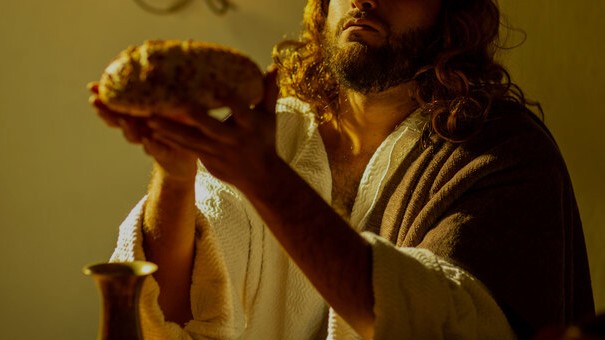
For further study, here are other notable instances of Jesus praying:
- He went to the mountain to pray before crossing the Sea of Galilee (Mt.14:23)
- He thanked God for the Passover meal (Mt.26:26, Mk.14:22, LK.22:17-19)
- He prayed during his baptism (Lk.3:21)
- He prayed alone before asking disciples, “Who do you say I am?” (Lk.9:18)
- He went to the mountain to pray with Peter, James, and John before his transfiguration (Lk.9:28-29)
- He was praying alone when the disciples asked him to teach them how to pray (Lk.11:1)
- He commanded Lazarus to come forth if you consider this a praying (Jn.11:43)
- He blessed the food with the two disciples on the road to Emmaus (Lk.24:30)
- He thanked God for bread and fish to feed the 5,000 (Jn.6:11)
- He prayed to glorify God’s name (Jn.12:28)



 word-centered living
Leave a comment