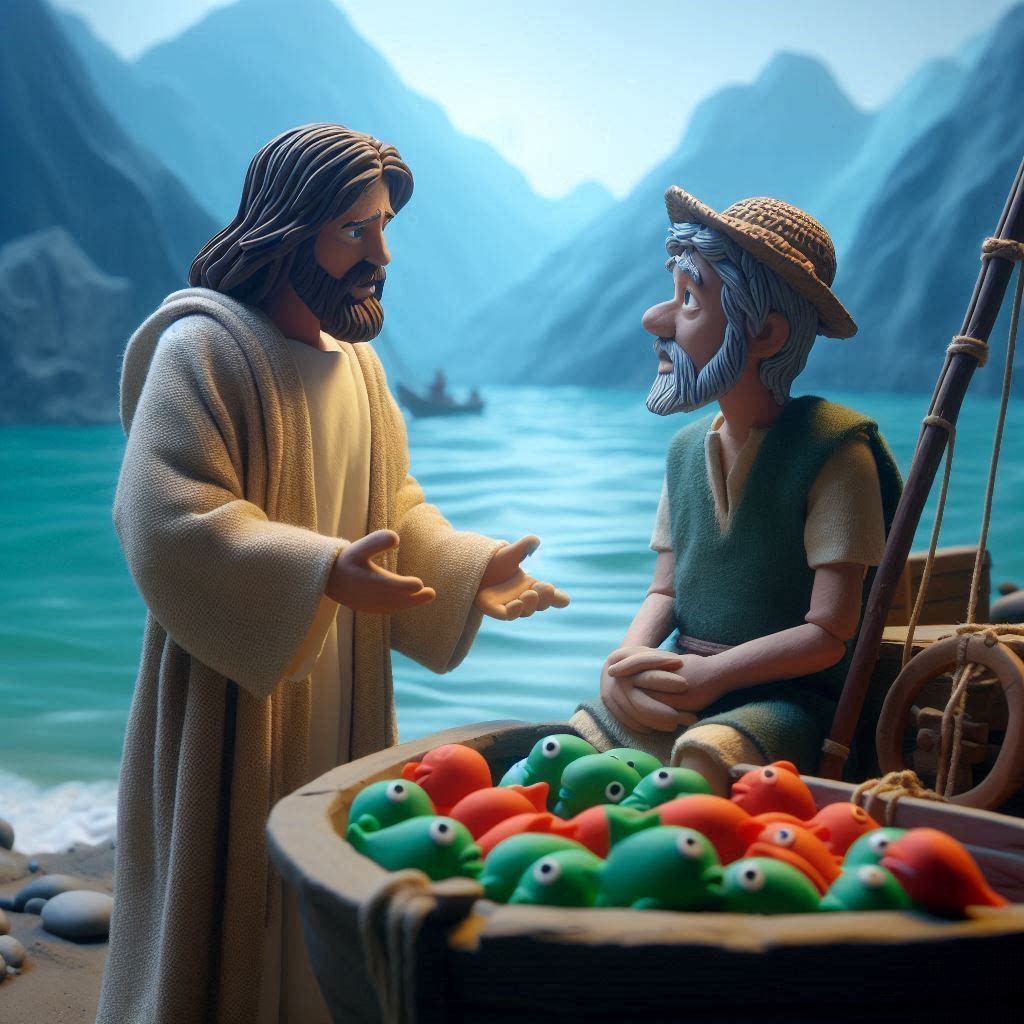
One of the disciples of Jesus that I love is Peter. It’s probably because I can identify with him more than any other. He is impulsive, simple, emotion-driven, and rough around the edges. Yet, we can see over and over again Jesus working with him and trying to mold him into a usable and effective instrument for his Great Commission work. Why? I believe it was because he was a diamond in the rough. In other words, he was right in the heart, even though he was wrong about many things. I can identify with that, can’t you?
In the narrative we’re delving into today, the Lord presented Peter with a profound challenge – to deepen his understanding and experience of Him by placing his trust in Him. This challenge, my friends, is not just for Peter but for all of us. I believe verse 5 holds the key to unlocking this challenge. After a night of exhausting fishing, Peter was ready to call it quits, to clean the nets and head home. But then, Jesus appeared, disrupting his plans and asking him to go back out to the sea to fish again. How would you have reacted if you were in Peter’s shoes? Let’s explore how Peter responded to Jesus in some of the popular Bible translations:
“But Simon answered and said to Him, ‘Master, we have toiled all night and caught nothing; nevertheless at Your word I will let down the net.’” (New King Jams Version)
“Simon answered, ‘Master, we’ve worked hard all night and haven’t caught anything. But because you say so, I will let down the nets.’”(New International Version)
“And Simon answered and said, ‘Master, we worked hard all night and caught nothing, but at Your bidding I will let down the nets.” (New American Standard Bible)
“‘Master,’ Simon answered, ‘we have worked hard all night long and have not caught a thing. But if you tell me to, I will let the nets down.’” (Contemporary English Version)
“And Simon answered, ‘Master, we toiled all night and took nothing! But at your word I will let down the nets.’” (English Standard Version)
“‘Master,’ Simon replied, ‘we worked hard all last night and didn’t catch a thing. But if you say so, I’ll let the nets down again.’” (New Living Translation)
So, what do you think is the common thread here? Although different wording, the main idea comes through. Peter expressed frustration with unfruitful labor throughout the night but was willing to follow Jesus’ instruction and return to the sea. The key word is: “nevertheless” or “but.” I like the word “nevertheless” in the New King James Version and will stick with it for the rest of the article. The word “nevertheless” is pivotal. It says that I have two choices, and I can go in one of two directions, and the right one, according to the text, is going with Jesus. We desperately need this kind of attitude in our lives. It’s taking God’s Word above all things in your life: I feel down, sad, and hurt, but nevertheless at Your Word. My logic tells me it won’t work, but nevertheless at Your Word. I have things to do and places to go, but nevertheless at Your Word. I am weak, inadequate, and ability-less, but nevertheless at Your Word. Can you trust God today by saying, “Nevertheless at Your Word,” I will obey? This is the main point of Peter’s encounter with Jesus and the key to us experiencing God on a deeper level.

The first lesson is that we need to be familiar with God’s word. It says in verse 1,
“So it was, as the multitude pressed about Him to hear the word of God, that He stood by the Lake of Gennesaret. “
Peter’s first step to experiencing God was becoming familiar with the words of God. When Jesus was preaching by the lake, Peter also listened. This is the first step to experiencing God on a deeper level. Faith originates from hearing God’s words. Apart from that, we can say that faith in God is non-existent. The Bible says, “So, faith comes from hearing, and hearing by the Word of Christ” (Rom.10:17). However, the idea of “hearing the word of God” must be more than just hearing sounds with our ears. Jesus made this perfectly clear in the Parable of the Two Builders (Mt.7:24-27). Both builders heard the words of Christ, but one acted upon it, and the other did not. To truly hear God’s voice, we must put on listening ears, that is, a willingness to put the word into action. For example, everyone can hear sermons each Sunday morning, but not everyone will hear the voice of God. When you hear the messages, you must come with an attitude, “What will God say to me this morning?” When you come to your Quiet Time, say, “What will God say to me through this passage?” When you encounter life’s trials, ask yourself, “What is God trying to say to me through this circumstance?” When you meet a godly and mature believer, say to yourself, “What is God trying to say to me through this person?” You must put on your listening ears and seek to understand what God is trying to say to you.
Furthermore, being familiar with God’s word is about recognizing God’s voice from other voices in the world. Indeed, many voices in the world try to tell you what is right and wrong, and some deceptively sound like God would say. Remember, the Bible says that even Satan comes to us disguised as an angel of light. To know the Heavenly Father’s voice, you must be his children. To know the Good Shepherd’s voice, you must be his sheep. Jesus said, “My sheep hear my voice, and I know them, and they follow me” (Jn.10:27). Notice the three verbs of relationship: hear, know, and follow. You cannot separate them. They are all interconnected. Are you able to “hear” God’s voice? Do you “know” God? Do you “follow” or obey what He tells you to do? If you answer yes, then you are “My sheep,” according to Jesus. Being familiar with God’s word takes place when you are familiar with Him, that is, having a loving relationship with Him. Are you a child of God? Are you a sheep of God? If you are, you will be naturally able to “hear” God’s voice. It is because there will be a sense of intimacy between you and God.

The second lesson is that we need to take baby steps of faith in God. In verses 2-3, it says,
“And saw two boats standing by the lake; but the fishermen had gone from them and were washing their nets. Then He got into one of the boats, which was Simon’s, and asked him to put out a little from the land. And He sat down and taught the multitudes from the boat.”
Now, the question arises as to why he particularly approached Peter. Was it by chance, or was it planned? There were two boats by the shore, and I’m sure there were other boats too, but why Peter’s boat? I guess that Jesus saw that Peter was faithful with baby steps, and now he was ready for the next step of faith. Likewise, if the Lord comes to you and asks if He can use some things in your life, would you say, “Why me? Why my things?” How would you respond if God came to you and asked you to use your possessions, time, and your life? What are you going to say? If Peter had said, “No,” that would have been it. No boat, no experience of God’s power and miracle. But Peter did say “Yes” and was able to go deeper with God. How was he able to do this? You see, Peter had already taken baby steps of faith before this event.
This incident was not Peter’s first encounter with Christ. It was probably his third or fourth encounter. In other words, Jesus did not just come out of the blue and ask if he could use the boat, go out again to fish, and call him to be a fisher of men. Peter took baby steps of faith in the past that helped him along. For instance, in the previous chapter, you can see that Peter already knew Jesus. Luke 4:38-39 says, “And He arose and left the synagogue, and entered Simon’s home. Now Simon’s mother-in-law was suffering from a high fever; and they made request of Him on her behalf. And standing over her, He rebuked the fever, and it left her; and she immediately arose and waited on them.” Also, John 1:41-42 says that Andrew, Peter’s brother, introduced him to Jesus, who gave him a new name, Cephas or Peter. Peter’s baby steps enabled him to offer up his boat to be used as a pulpit for Jesus in his preaching ministry.
Jesus worked with a “faithful in little, faithful in much” principle. Luke 16:10 says, “He who is faithful in a very little thing is faithful also in much; and he who is unrighteous in a very little thing is unrighteous also in much.” Yes, God comes to us and gives us small tasks that can enable us to exercise our faiths. When we are faithful, He entrusts us with more. But when we are unfaithful, He will not go further with us. God encourages us to take baby steps of faith regularly. He comes to us and asks if He can use small things in our lives. He asks us to give Him a small portion of our time. When God asks, “Do you have time?” He is not asking what time it is but whether we can spare our time. When you demonstrate to God that you can take these baby steps of faith, He will come to you with more significant challenges.

The third lesson is that, from time to time, we must boldly venture into the deep waters of faith. It says in verse 4,
“When He had stopped speaking, He said to Simon, ‘Launch out into the deep and let down your nets for a catch.’”
Notice that after Jesus finished his preaching, he turned to Peter to challenge him personally. He challenged the veteran fisherman to go out again to fish. Peter was an expert fisherman. Jesus was a carpenter-turned-preacher. If you were Peter, what would you have thought? If it were me, I would have put Jesus in his place. I would have said something like, “Jesus, I appreciate your help, but what do you know about fishing? My partners and I worked hard all night, but it didn’t work. What can you do?” Peter didn’t respond that way. In verse 5, he said, “Master, we have toiled all night and caught nothing; nevertheless at Your word I will let down the net.” What a response! Peter decided that he was going to trust in Jesus’ word rather than his logic, experience, know-how, or circumstances. This is what it takes for us to venture out into the deep waters of faith.
These words remind me of how God tested Abraham and how he responded to God. Abraham had heard the call of God and moved his family from the Ur of Chaldeans and was living in the land of Canaan. In other words, Abraham already had a relationship with God and walked with Him when he was tested to sacrifice his son Isaac. Genesis 22:1-2 says, “Now it came about after these things, that God tested Abraham, and said to him, ‘Abraham!’ And he said, ‘Here I am.’ And He said, ‘Take now your son, your only son, whom you love, Isaac; and go to the land of Moriah; and offer him there as a burnt offering on one of the mountains of which I will tell you’” Yes, our walk with God generally involves taking many baby steps of faith that can build up to one or two deep waters of faith. Going deep with God happens when we successfully take baby steps with Him.
Peter had taken his baby steps and was now ready to take the mature step of faith. He needed to trust God’s Word over what he knew to be accurate, experienced to be true, and assumed to be right. Remember, Peter was an expert fisherman by trade who knew all about the fishing business. However, venturing out into the deep waters of faith required a change of perspective on his part. It was about taking his eyes off himself and what he could do and focusing on God and what He could do. This is the hard part, but it is not impossible. Thus, venturing into the deep waters of faith requires two necessary actions. You must leave something behind (self-reliance, self-sufficiency, self-centeredness) and follow something ahead (the promise of Christ).

The fourth lesson that we can learn is that we need to have an “all-in” attitude of commitment. When Peter ventured out into the deep waters of faith, he and his companions experienced a miracle. They began catching a significant quantity of fish that their nets were about to break apart and signaled to their partners to come and help. As a result, both their ships were filled with fish, and the boats began to sink. What a fantastic experience! Then Peter started to see Jesus in a different light. In verse 8, Peter confessed,
“Depart from me, for I am a sinful man, O Lord!”
He was no longer seeing a carpenter-turned-preacher but a divine being who knew all about him and everything around him. This is a common experience of people who have profound encounters with God. Moses stood on holy ground before God and heard His voice from the burning bush, but the Bible says that he was afraid to look at God and hid his face (Ex.3:6). Prophet Isaiah saw the glory of God and cried out, “Woe is me, for I am ruined! Because I am a man of unclean lips, and I live among a people of unclean lips; for my eyes have seen the King, the LORD of hosts” (Isa.6:5). When we experience God in such a way, we recognize who God is and who we are in His presence. He is God, and we are not. He is holy, and we are wretched sinners. Even the best of our righteousness appears to be filthy rags compared to His righteousness.
At this moment, Jesus revealed his true intention for encountering Peter. Verse 10 says,
“And Jesus said to Simon, ‘Do not fear, from now on you will be catching men.’”
Yes, this was the ultimate purpose of Jesus coming to Peter, asking permission to use his boat and challenging him to go back out to sea. And Peter responded with an A+ response to Jesus’ calling. Verse 11 says,
“And when they had brought their boats to land, they left everything and followed him.”
Apostle Paul, quoting the words of Prophet Habakkuk, wrote, “But the righteous man shall live by faith” (Rom.1:17, Hab.2:4). Yes, God leads His children to walk by faith, whether in baby steps or mature steps, so that we can have an all-in attitude toward Him. Whether you are tasked with baby steps or mature steps, they hinge on whether you will have a “nevertheless at Your Word” act of faith. Hebrews 11:6 says, “And without faith it is impossible to please Him, for he who comes to God must believe that He is, and that He is a rewarder of those who seek Him.”

Your faith is only as good as its object. The big question is: What or whom do you believe? If the object of your faith is a concept, object, or feeling, then your faith is as strong as those things. But if your faith is in God, then your faith will be as strong as God. Until now, you may have been operating on your experiences, training, upbringing, feelings, know-how, and habits, but now you are going to trust God in His Word. Go all-in faith with your possessions. Go all-in faith with your future plans. Go all-in faith with your relationships. Say to God, “Nevertheless at Your Word,” and launch out on a journey to go deep with God.



 word-centered living
Leave a comment